Helping doctors request DNA tests and read results without ambiguity.
Built for the doctors who work with a DNA testing laboratory: ordering the tests, keeping the patient’s history in one place, and making sense of the results.

Project
Name
Health Platform
Deliverable
UI/UX · Design system
Year
2024
At a glance
Duration
5 months
Role
Sole designer
Documented in a single shared library
~100 markers
Patient-facing layouts designed
12+ reports
The starting point
Everyone had their own setup
The process ran on external software and whatever each doctor had put together for themselves. A patient’s history, their tests and their results lived in different places, and nothing connected the patient directly to the doctor ordering the test.
The real problem
A hundred markers, and nowhere to look them up
Interpretation posed a greater challenge than organization.
Tests are measuring biological markers whose meaning differs according to whether their value is above or below range and according to which markers are affected alongside them. The laboratory’s internal specifications are detailed and meant for experts only; certainly far too detailed to discuss with a patient looking at you.
There were four limitations guiding the process. The interface design was based on INDE and therefore restricted the patterns that could be applied. There was the limitation that nothing could be vague: misunderstanding a marker could cause serious repercussions, something a design error usually wouldn’t have. There had to be growth from the client’s established brand identity, not a replacement. Finally, there were two users for one set of information: the doctor interpreted the results while the patient got a report.
Decision
One library, two ways in
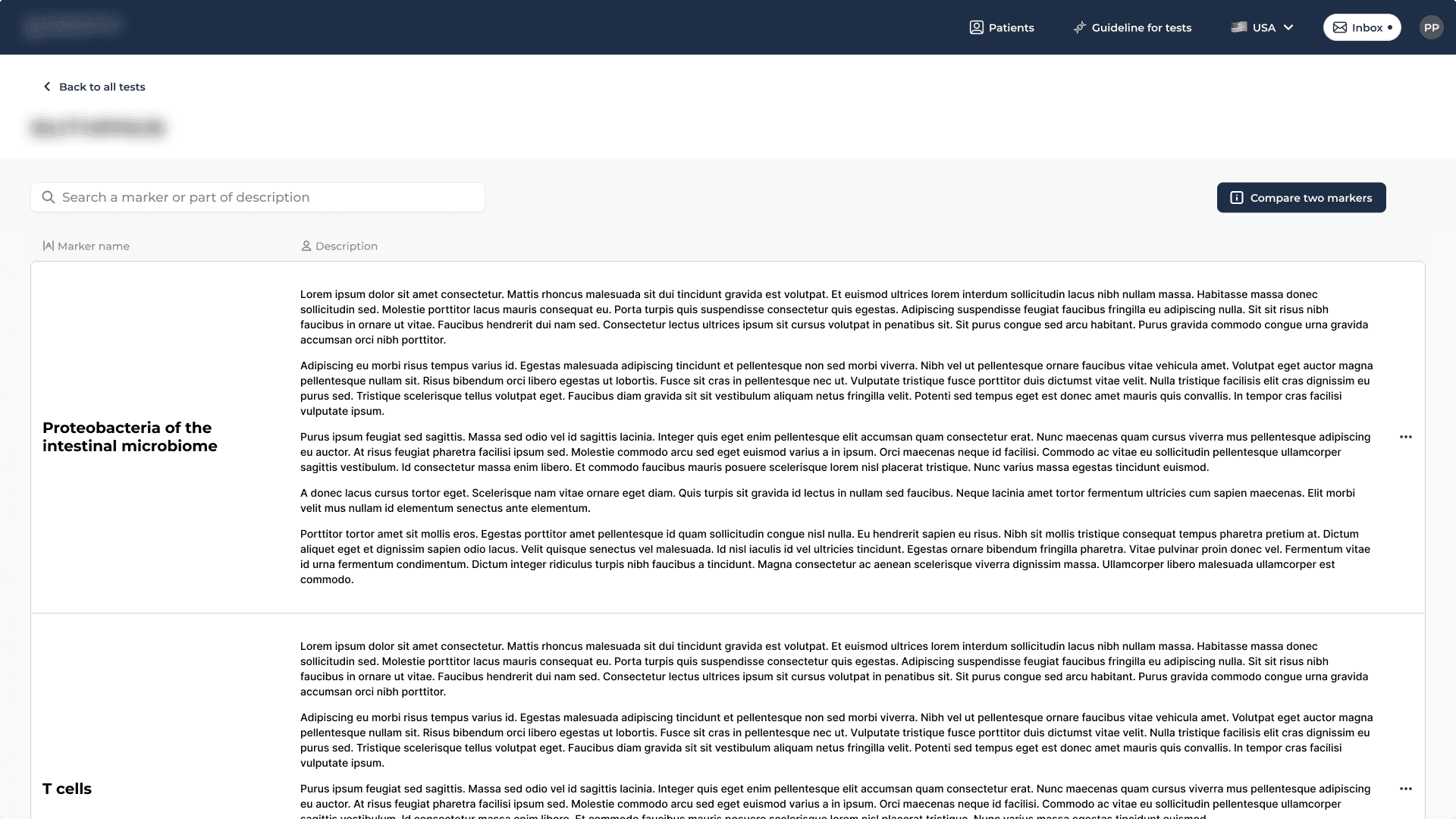
A number of about a hundred markers is used in common for all tests conducted in the laboratory. This particular marker is repeated in different tests.
Instead of making explanations about each marker in each individual test, we created one library where there is every marker with information about its function and what it means if it has high value and what if it has low value. Physicians get to this library from any test or from any marker.
Interpretation
Reading two markers together
Interpretation gets difficult when more than one marker is altered at once.
When a doctor selects two, the platform surfaces a written explanation of how they interact: the part that previously sat buried in the guidelines, or in the doctor’s own memory.

The flow
Splitting the flow
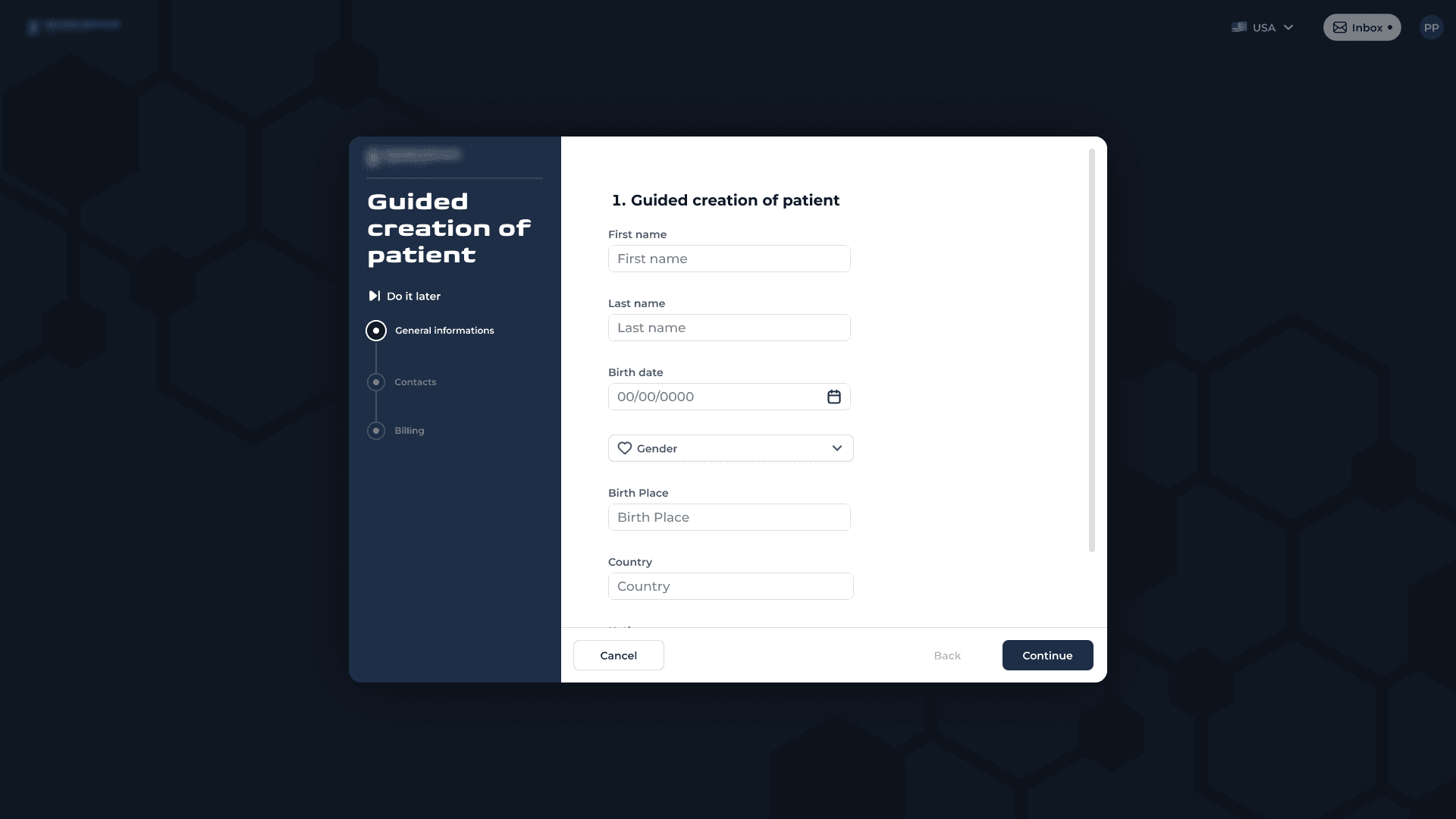
Creating a patient and ordering an exam are separate steps, on purpose.
The patient completes their medical history through a form sent from the platform. The doctor then finds a record already populated, opens it as a refresher, edits it if needed, and moves to the exam panel with the patient’s data still in view. Nothing asks them to remember a detail from the previous screen.
The reports
The report goes to the patient, the platform stays with the doctor
More than a dozen report layouts, combining values, reference ranges, charts and written explanations.
These are read by someone with no clinical training, so the hierarchy and the writing had to make the results understandable without flattening what the numbers actually say. Every marker carries its range, its position in that range, and what a deviation means, in that order.
Design system
One component, in full
The component library built here is the most complete we have delivered, and it is now the basis for every test the laboratory offers.
Detailed enough for developers to implement directly: every state defined, every variant drawn, built on the client’s existing brand rather than beside it.

Let’s create
great things.
How do you work?
We keep things transparent and collaborative. We share updates consistently throughout the process, so nothing comes as a surprise. Weekly 1-to-1 meetings keep the work aligned and give space to review what's been done and plan what's next.
Why should I choose Heterochromia?
We work fast and we have an opinion. We don't just ask "what do you want?" and execute. We guide you through the process, challenge your assumptions when needed, and help you get to something better than what you imagined. Damn, we love what we do.
Do you do outsourcing?
Over the years, we have met a lot of talented people. Some of them work with us regularly on projects that require specific expertise.
What timezone are you in?
We are based in Milan, Italy (CET/CEST), but we work with clients in the USA and Japan with full flexibility.

